
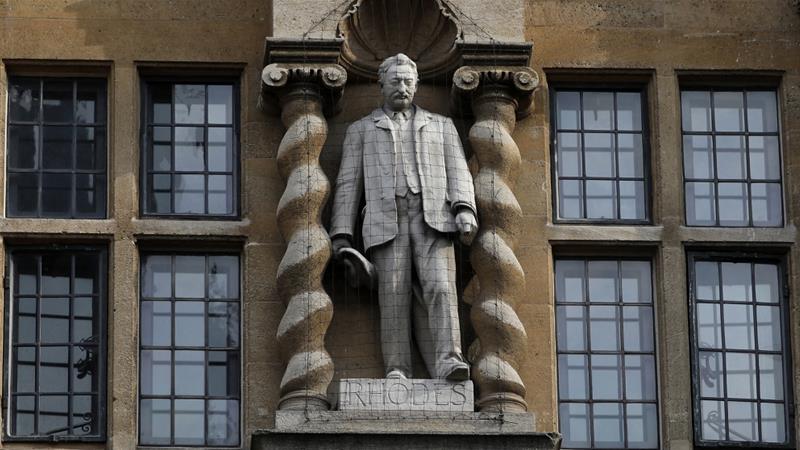
The governors of the Oxford University college voted on Wednesday to remove the statue of the colonialist, this follows calls from protesters and campaigners to have the statue taken down claiming it was a symbol of imperialism and racism.
Following the pressure from activists, Oriel College in Oxford has announced that it wants to take down the controversial statue of Cecil Rhodes.
The removal is not set to be immediate as the college says there will need to be consultations over planning regulations.
The Rhodes Must Fall campaigners said the announcement was “hopeful” about the announcement but claimed they would remain cautious until the college had actually carried out the removal.
In a statement, campaigners said that until the “Rhodes statue ceases to adorn the facade of Oriel College on Oxford’s High Street” there would still be protests over “imperial and colonial iconography” in university buildings.
Oriel College’s governors said the decision had been reached “after a thoughtful period of debate and reflection” and in “full awareness of the impact these decisions are likely to have in Britain and around the world”.
The college is also set to launch an “independent commission of inquiry” into the legacy of Cecil Rhodes, which also includes scholarships at the university.

Susan Brown, Leader of Oxford City Council, backed the decision to take down the statue claiming the college’s inquiry would be a chance to decide where the statue will “best be curated in future”.
However, some did not take kindly to the announcement former Conservative MEP Daniel Hannan tweeted that “Rhodes’s generosity allowed thousands of young people to enjoy an education they could not otherwise have had.
“Why would anyone give to an institution that treats its benefactors this way?”
The Universities Minister has spoken against calls to remove the statue Michelle Donelan said it would be “short-sighted” to try to “rewrite our history or attempt to “censor or edit” the past.
“I want to be really clear that racism is abhorrent and shouldn’t be tolerated anywhere in our society, and that includes universities,” she told a Higher Education Policy Institute event.
Vice-chancellor of Oxford University, Louise Richardson warned against “hiding” the past.
“My own view on this is that hiding our history is not the route to enlightenment,”
“We need to understand this history and understand the context in which it was made and why it was that people believed then as they did,” she said.
“This university has been around for 900 years. For 800 of those years the people who ran the university didn’t think women were worthy of an education. Should we denounce those people?
“Personally, no – I think they were wrong, but they have to be judged by the context of their time,” said Prof Richardson.
[give_form id=”1772″ show_title=”false” show_goal=”false” show_content=”below” display_style=”modal”]

Editor-in-Chief | Carl D. Pearson has been involved in British politics and media from an early age, with the key knowledge of what it takes to run a news organisation for the 21st century. Mr Pearson, as Editor-in-chief, is responsible for supervising the daily tasks of publishing media and content to UNN’s website and various platforms.
[sibwp_form id=4]
