
On 14th August the Government responded to a Petition on its website asking that they “Repeal the decision to implement compulsory face coverings in English shops.”
The petition garnered 29,043 signatures.
All petitions reaching 10,000+ signatures receive a Government Department response. Upon reaching 100,000 signatures the Petitions Committee then consider it for debate within Parliament.
The Petition states
“Reverse the decision to implement compulsory face coverings in English Shops.
Implementing compulsory face masks in English shops could have a severely bad effect on the UK economy. This decision could deter many people from shopping in the retail sector and severely hinder the wider economic recovery after easing of the UK lockdown.

Making face masks mandatory in shops could force retail businesses towards financial hardship because of a decline in footfall and revenues. This could result in mass unemployment throughout the retail sector.”
The Government’s response
People must play their part to reduce the spread of the virus. Wearing a face covering helps this, giving people the confidence to return to shops safely, and better protects those who work in retail.
The government is telling the public to play their part and wear face coverings in order to help fight the spread of the virus, enabling further easing of national restrictions.
Coronavirus (COVID-19) usually spreads by droplets from coughs, sneezes and speaking. These droplets can also be picked up from surfaces, if you touch a surface and then your face without washing your hands first. This is why social distancing, regular hand hygiene, and covering coughs and sneezes is so important in controlling the spread of the virus. There is evidence to suggest that, when used correctly, face coverings may reduce the likelihood of someone with the infection passing it on to others, particularly if they are asymptomatic. Because face coverings are mainly intended to protect others, not the wearer, from coronavirus (COVID-19) they are not a replacement for social distancing and regular hand washing.
Since 11 May, the Government has been advising people to wear face coverings in enclosed indoor spaces, where they cannot easily social distance, and where they come into contact with people they do not normally meet.
The wearing of face coverings has been required on public transport since 15 June.
In recent weeks, some lockdown restrictions have been eased and the retail sector has reopened. As footfall increases, we want to give people more confidence to shop safely, and enhance protections for those who work in shops. The British Retail Consortium has said that together with other social distancing measures, face coverings can make shoppers feel even more confident about returning to the high street.
The Government has published guidance online which sets out when the public need to wear one and how they can make their own. There are exemptions for those who are unable to wear a face covering due to age, health, disability, and other reasons. There has been an ongoing assessment as to the impacts of the Government’s policy, including on groups with protected characteristics, that has informed decision making.
The Government is running a proactive communications campaign on face coverings to alert the public where they are now required to wear a face covering, who is exempt from wearing one, and how to wear one correctly. We are actively engaging with stakeholders including disability charities to communicate new guidance to their members as well as highlighting this message to the general public on social media and via broadcasting opportunities.
On 31 July the Prime Minister announced that the face covering regulations will be extended to cover further indoor settings such as places of worship from 8 August.
We will keep advice on the use of face coverings under review, in line with the latest scientific evidence.
Analysis
So no answer to the question just a longwinded “justification” for the policy, and subsequently we have seen the Johnson Government raising fines for non-compliance – I guess we have our answer.
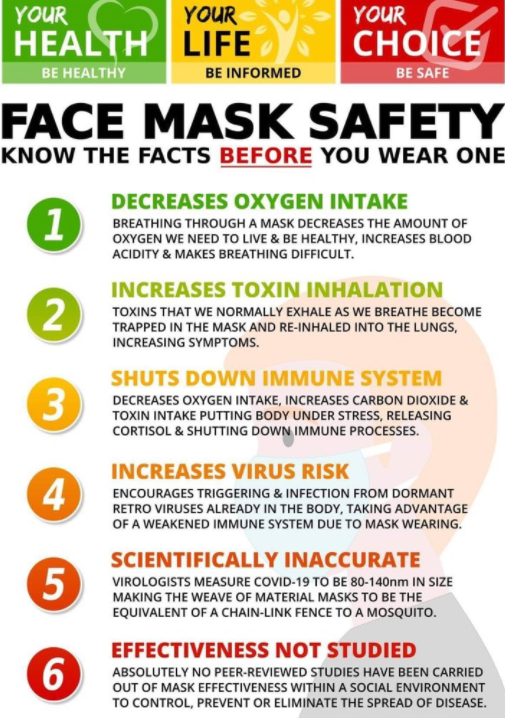
- Has there been a medical risk assessment for mask wearing in a social setting?
Medical experts have voiced their concerns regarding:-
Hypoxia – low oxygen in your tissues when your blood doesn’t carry enough oxygen to your tissues to meet your body’s needs.
Hypercapnia a build up of carbon dioxide in your bloodstream.
There is still little to no scientific evidence for the effectiveness of cloth face masks in healthy and asymptomatic individuals. Experts warn that such masks may interfere with normal breathing and become “germ carriers” if used repeatedly.
Swedish Chief Epidemiologist Anders Tegnell states – in Sweden, the infections slowed down considerably even without a lockdown, and daily deaths now are close to zero.
The evidence for the benefit of masks is still “very weak” and they might even be counterproductive. An introduction of masks at this point in time would make no sense.
The lethality of Covid-19 is between 0.1% and 0.5% and does not “radically differ” from influenza.
Q2 Who is setting Government policy and why?
Will these questions be answered – I wouldn’t hold your breath!
https://swprs.org/a-swiss-doctor-on-covid-19/
https://www.nejm.org/doi/full/10.1056/NEJMp2006372


I wrote my first article for Unity News Network on 30th December 2019, and I have been writing ever since – my library is now well in excess of 200 articles.
Alternative media is essential in these times of unprecedented censorship and mainstream bias, which has ramped up exponentially during the past 2 years. The overton window of “acceptable opinion” is growing every narrower.
Having a citizen’s log, cataloguing the twists and turns of life during these turbulent times is essential.
Thank you Unity News Network for allowing me a voice on your platform.
