
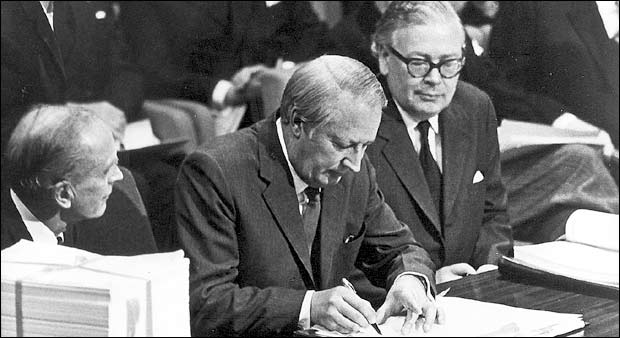
Lord David Owen has recalled and slammed the former Prime Minister Edward Heath for what he sees as the betrayal of British fishermen and our waters.
During an interview with the Express, Lord Owen said British fishermen should not worry, as Prime Minister Boris Johnson will deliver on his promise and give them back full control of their waters, reversing former Prime Minister Edward Heath’s betrayal.
He said: “It was a scandal.
“Ted Heath traded in our waters.
“Over the years, people have pointed out that fishing is a small part of our economy.
“That doesn’t matter, there are things you cannot trade-off.”
The former Foreign Secretary and SDP co-founder said: “Trying to make fishing as part of the FTA – I don’t think that has ever been done before and it is certainly provocative.

“Of course, we will allow many EU countries in UK waters but we will do it like Norway does, as an independent country.
“I don’t think Brussels has understood that we are going to be separate now, but we will be able to overcome that.”
He added: “This Government, in particular, has sworn that it will not do what Ted Heath did, so there is no chance whatsoever we will cave into Brussels’ demands.”
Mr Heath, then Prime Minister, dismissed the notion that he had betrayed British fishermen as “absurd and insulting”.
According to a 2000 report by the Daily Telegraph, Sir Con O’Neill, the diplomat who led British officials in the delegation to negotiate Britain’s membership of the EEC, wrote that PM Heath would have sacrificed anything to join the EEC in the early Seventies.
The report by Sir Con claims that the principle to guide the negotiations at the time between 1970 and 1972 was “swallow the lot and swallow it now”, as the only thing that mattered was to get in.
One of the things Britain was ready to “swallow” included its fisheries, according to the report.
The diplomat acknowledged mistakes in the fishing talks, as he claimed his negotiating team “failed to foresee the way in which, and the intensity with which, political pressures on the question of fishing limits would develop”.
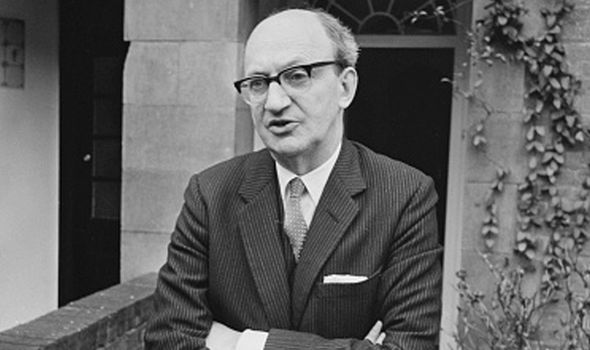
Sir Con’s accounts suggest that British negotiations could have stopped the adoption of the Common Fisheries Policy (CFP) if they had realised how big of an issue it would become.
He wrote: “I have no doubt that we made mistakes.
“The first was in not trying harder than we did to stop the adoption of a common fisheries policy. I believe we could have at least postponed such an agreement; and if we had, it is possible, though questionable, that we could have postponed it indefinitely.
“Almost a year later, we made a major mistake in putting the proposals we put to them on June 1, 1971.
“Why was our handling of the issue of fisheries far more uncertain, and more faulty, than our handling of other issues?
“We did not at the outset realise how acute the question would become and, in part, our retreat from our opening position and the gradual stepping up of our demands was due simply to the mounting political pressure exercised upon us.”


Editor-in-Chief | Carl D. Pearson has been involved in British politics and media from an early age, with the key knowledge of what it takes to run a news organisation for the 21st century. Mr Pearson, as Editor-in-chief, is responsible for supervising the daily tasks of publishing media and content to UNN’s website and various platforms.
[sibwp_form id=4]
