
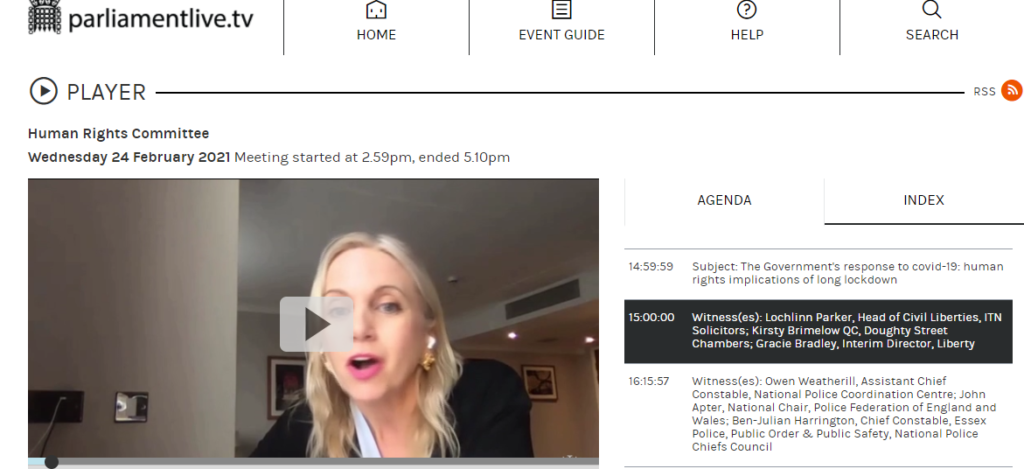
On 24th February 2021, A virtual 2-hour Parliamentary Human Rights Committee meeting was held.
-
Subject: The Government’s response to covid-19: human rights implications of long lockdown
-
Witness(es): Lochlinn Parker, Head of Civil Liberties, ITN Solicitors; Kirsty Brimelow QC, Doughty Street Chambers; Gracie Bradley, Interim Director, Liberty
-
Witness(es): Owen Weatherill, Assistant Chief Constable, National Police Coordination Centre; John Apter, National Chair, Police Federation of England and Wales; Ben-Julian Harrington, Chief Constable, Essex Police, Public Order & Public Safety, National Police Chiefs Council
Issues on the agenda were human rights during the “covid pandemic”.
The right to demonstrate, the right not to be detained unlawfully, the right to free speech, the right to protest, the right not to be dealt with unfairly by the criminal justice system.
Also discussed was fixed penalty notices, issued in order to enforce the regulations and restrictions. The size of the fines, at £10,000 are they excessive? Normally FPNs are no more than £500.
Whether or not people have adequate rights to challenge those fines, whether the FPNs are issued fairly or in a discriminatory way and whether the right to peaceful protest is adequately protected and what is the situation in relation to police entering people’s homes to enforce no gathering rules. https://parliamentlive.tv/Event/Index/8d216e31-a2e1-46fb-a87a-c3cef5e227eb

The main focus of this article is our basic human right to peacefully protest.
The Right to Peacefully Protest and How the Regulations are Being Applied
Joanna Cherry (SNP) speaking to Kirsty Brimelow QC of Doughty Street Chambers stated…..
“Kirsty I am very interested in what you said about the regulations being made under the public health act, not really there for public order.”
What are the impact of these regulations, the restrictions on people’s right to peaceful protest, people’s rights of freedom of expression and freedom of assembly.
Do you think these restrictions have been reasonable and do you think the law insofar as it impacts on our rights under Article 10 and Article 11 of the ECHR has been accessible and foreseeable having regard to the frequent changes in the law and the sometimes conflicting messages coming from the police and government – thinking back to the BLM protests last summer?”
Kirsty (lawyer) responds…”the laws have been completely inaccessible and opaque we have seen that not only through the statistics from the CPS of so many wrongful prosecutions no one is suggesting these are deliberate and malicious, people are just confused and that goes all the way to those who are sitting in positions as being District Judges and similarly with the fixed penalty notices. The law is being wrongly applied which shows it is not accessible.
The regulations now are around 130 pages long, they are not even linked specifically quite often to the guidance, even the lawyers get confused going through them and when you look at laws that are inaccessible what that means is that they themselves might be unlawful. In order for a law to be lawful it has to be clear and accessible. So that People have to be aware they have committed an offence. People no longer know where they stand.
In relation to protests people are confused there were regulations entirely silent about protests. Then there was a specific exemption brought into the regulations protecting rights to protest and then it was removed – it is now silent again – it is clearly not satisfactory.
Protest has never been banned even when it has been silent in the regulations it has still been allowed. It is a common law right enhanced by the Human Rights Act – the police have a duty to facilitate protest regardless of what the regulations say.
Restrictions on protests potentially have a chilling effect particularly with a pandemic. There is a lot of frustration, upset and anguish and people need to be able to express that. The guidelines are on public health advice they should be split apart there should be no connection with criminal law.
Articles 10 and 11 are qualified rights
Article 10 protects your right to hold your own opinions and to express them freely without government interference
Article 11 protects your right to protest by holding meetings and demonstrations with other people
There is absolutely no reason why protest cannot take place with sufficient safeguards around them and when you look at what the regulations allow they now allow unlimited numbers within church services for example certainly under tier 4, so there is a lot of illogicality around where the red lines are drawn. That has led to a lot of the frustration.
It is very important we must protect our right to free speech and right to gather.
The issue that has become very problematic is how restrictions are enforced what restrictions are decided and how the police go about doing that – the four E’s are Engage, Explain, Encourage and Enforce. There is a fundamental flaw there if the police are confused regarding the regulations. There needs to be greater clarity and understanding from the police around facilitating protest.
Analysis
So there you have it folks our rights under Articles 10 and 11 are qualified rights and remain in effect under common law.
Perhaps someone ought to tell the police, especially the Met police who it appears are not only breaching human rights on a regular basis but also guilty of wasting Court time.
https://parliamentlive.tv/Event/Index/8d216e31-a2e1-46fb-a87a-c3cef5e227eb
https://www.youtube.com/watch?v=RDvrSfMuIgU&feature=youtu.be


I wrote my first article for Unity News Network on 30th December 2019, and I have been writing ever since – my library is now well in excess of 200 articles.
Alternative media is essential in these times of unprecedented censorship and mainstream bias, which has ramped up exponentially during the past 2 years. The overton window of “acceptable opinion” is growing every narrower.
Having a citizen’s log, cataloguing the twists and turns of life during these turbulent times is essential.
Thank you Unity News Network for allowing me a voice on your platform.
